The assessment criteria for the Writing sub-test is a set of standards OET examiners use to assess the quality of your writing. Let me explain it, in the Listening and Reading sub-tests of OET, you have answer keys. The answers (words, numbers, short phrases, and characters -A, B, C, D), are pre-determined and as per the key, your answers are either right or wrong.
However, in OET Writing and Speaking sub-tests individual student responses may vary according to the choice of words and grammar, organization of the information, etc. Therefore, as a standard English test, OET uses a set of criteria to assess and score your answers.
In this lesson, we are looking into the OET Writing assessment criteria and trying to decode them so that you can successfully employ them in your answer to get a great score.
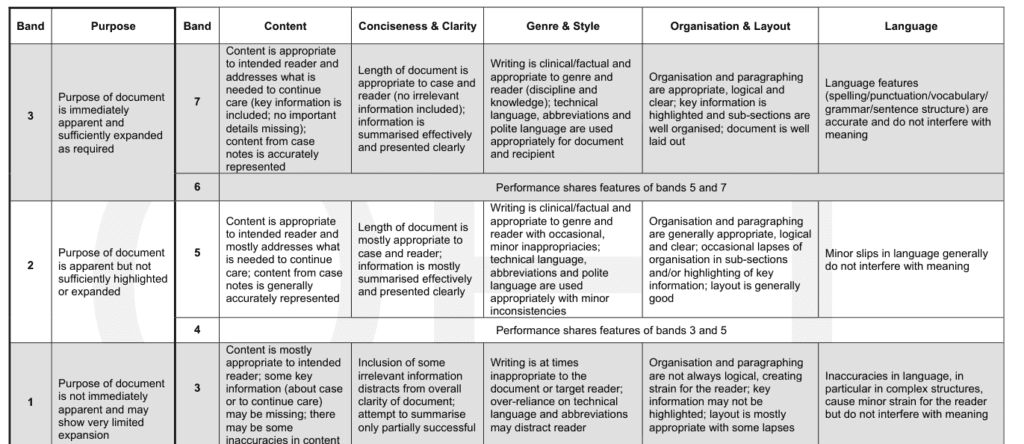
These are the six criteria used for the assessment of the OET writing sub-test.
- Purpose
- Content
- Conciseness & Clarity
- Genre & Style
- Organisation & Layout
- Language
The Purpose is scored on a scale of 0 – 3, while the rest is on 0-7. According to OET, to get a Band B or 350 above in the writing sub-test, you need to score at least 2 in the Purpose and for the rest 5 out of 7.
1. Purpose
“The purpose of the document is immediately apparent and sufficiently expanded as required”
- The purpose or the reason for writing the letter should be clear in the first paragraph itself.
- The purpose should be sufficiently expanded usually at the end of the letter.
Explanation
This assessment criterion examines one of the important aspects of letter writing – if you were able to make the reader of your letter understand why you are writing to them. Given the time constraints faced by health professionals, it is imperative for them to swiftly grasp the purpose of letter, with efficiency.
It is crucial that the purpose is readily and unmistakably identifiable to the reader, eliminating the need for any extra effort to discern it.
2. Content
“Content is appropriate to the intended reader and addresses what is needed to continue care (key information is included; no important details missing); content from case notes is accurately represented.”
- All the important information from the case notes is included in the letter
- The information is accurate
Explanation
The Content criterion checks whether you have included the relevant information from the case notes in your letter and the accuracy of the information.
The relevancy of the information revolves around its appropriateness for the intended reader and its relevance to sustaining care. It is essential that the content is tailored to the reader’s level of knowledge regarding the case (their profession) and addresses the necessary information required for ongoing care (their previous knowledge of the patient).
3. Conciseness & Clarity
“The length of the document is appropriate to the case and reader (no irrelevant information included); information is summarised effectively and presented clearly.”
- Whether any unnecessary information from the notes is included (how distracting this may be to the reader)
- How well the information is summarized
Explanation
The Conciseness & Clarity criterion assesses the document’s length in relation to the case and reader (the number of words is not very relevant here but the relevance of the information is the question), ensuring the absence of irrelevant information and effective summarization for clear presentation.
Health professionals prioritize communication that is both concise and clear. The OET evaluates your letter for the inclusion of unnecessary information from the notes its potential to distract the reader and its impact on clarity. It also examines the effectiveness of summarizing the case information and how well this summary is conveyed to the reader.
4. Genre & Style
“Writing is clinical/factual and appropriate to genre and reader (discipline and knowledge); technical language, abbreviations and polite language are used appropriately for document and recipient.”
- The use of genre (medical and non-medical vocabulary and style, abbreviations, etc.)
- The appropriateness of the tone, and register of the letter.
Explanation
The Genre & Style criterion evaluates whether the writing is fitting to the specific genre and reader’s expertise.
It emphasizes the appropriate use of technical language, abbreviations, and polite language tailored to the document and recipient.
Your letter should show an awareness of genre (the style of English used in the clinical and medical setting or called English for medical purposes) by adopting a clinical and factual tone and avoiding personal feelings and judgments.
The writer should also consider the professional register and tone (formal, the level of technical language used, politeness, etc.) suitable for the reader’s discipline and knowledge level. The use of abbreviations and technical terms should be judicious, taking into account the common knowledge of the recipient. If the letter is addressed to a medical colleague within the same discipline, abbreviations, and technical terms may be more acceptable. However, if the recipient is from a different discipline or if the letter is from a specialist to a general practitioner, it is advisable to provide more explanation and use fewer abbreviations.
In cases where the target readership includes the patient, it’s important to word the information in a way that minimizes medical jargon, ensuring clarity and understanding.
5. Organisation & Layout
“Organization and paragraphing are appropriate, logical, and clear; key information is highlighted and sub-sections are well organized; the document is well laid out.“
- The organization of the information – the paragraphing and highlighting of the important information.
- The layout of the letter
Explanation
The Organisation & Layout criterion focuses on the appropriateness, logic, and clarity of the document’s organization and paragraphing.
Health professionals appreciate documents that are well-structured, facilitating efficient retrieval of relevant information. This evaluation considers the appropriateness of paragraphing, the logical organization, and the clear highlighting of key information. The goal is to make it easy for the reader to locate essential details without difficulty. Additionally, the criterion assesses the overall layout, and whether it is appropriate for a letter.
6. Language
“Language features (spelling/punctuation/vocabulary/ grammar/sentence structure) are accurate and do not interfere with meaning.”
- Accuracy of the grammar and vocabulary.
- Easiness of understanding and reading speed of the letter.
Explanation
The Language criterion evaluates the accuracy and appropriateness of language features, including spelling, punctuation, vocabulary, grammar, and sentence structure.
In OET letters, the grammar and vocabulary elements are considered only in terms of their impact on the ease of retrieving information. The assessment focuses on ensuring that language is precise and does not impede the reader’s comprehension or reading speed.
Conclusion
As we wrap up our exploration of the OET Writing Assessment, think of it as your map to success in expressing yourself effectively. Each criterion, if you understand them well, opens the doors to a Band B or even higher.
Imagine your writing as a powerful tool, where every word serves a purpose, and your message is crystal clear. The ability to express yourself with brevity, adapt your style to your audience, keep things organized, and use impeccable language – these are the tricks that will make your writing stand out.
Think of the OET not just as a test, but as your passport to communicating well in the medical world. Let these criteria be your helpful companions on your journey, guiding you to success in the OET Writing Sub-Test.
Now, with this knowledge in your pocket, move forward with confidence. Use these criteria, polish your writing skills, and see how your proficiency turns into success. Your story of triumph in the OET is ready to be written – make it clear, make it yours!