In this grammar lesson, I’ll show you a straightforward approach to crafting complex sentences. We’ll keep things easy, steering clear of intricate grammar details and skipping the use of relative pronouns like ‘who’ or ‘whom.’ Instead, let’s focus on a simpler method to make your sentences more intricate without getting bogged down in complex rules.
Ready to craft compelling complex sentences? Let’s dive in!
Why you should complex sentences?
Complex sentences give clarity and precision: Complex sentences allow you to express different ideas and relationships between these ideas in a more precise manner. They provide an opportunity to add details to the information thereby enhancing the overall clarity of your writing.
It provides coherence and flow:
Well-constructed complex sentences contribute to the flow and coherence of your writing. They help connect ideas logically, creating a smooth and organized structure.
It makes your sentence concise:
While complex sentences involve more components, they can sometimes convey information more in a brief and clearly expressed manner than a series of simple sentences.
It increases your range of grammar structures:
Complex sentences offer a greater range of syntactical structures, allowing you to vary your writing style and convey different shades of meaning.
Formality and Academic Writing:
In academic and formal writing, complex sentences are often expected. They demonstrate a higher level of language proficiency and are suitable for conveying complex ideas commonly found in scholarly work. The English proficiency tests like IELTS assess candidates’ ability to write complex sentences.
Professionalism:
Using complex sentences appropriately can enhance the overall professionalism of your writing. It reflects a command of the language and an ability to communicate complex ideas effectively.
However, it’s important to strike a balance. Overusing complex sentences may lead to convoluted and hard-to-follow writing. It’s crucial to consider your audience, the context of your writing, and the specific requirements of the task at hand. Always prioritize clarity and readability.
In order to learn to make complex sentences properly, you should know what clauses are,
The clauses
In English grammar, a clause is a group of words that contains both a subject and a verb. Clauses can function independently as complete sentences or as part of a larger sentence. According to this, a clause can be an independent clause or a dependent clause.
Independent Clause:
An independent clause, also known as a main clause, is a group of words that forms a complete thought and can stand alone as a sentence.
Example: “The sun was shining.”
Dependent Clause:
A dependent clause, also known as a subordinate clause, is a group of words like an independent clause but cannot stand alone as a complete sentence. It depends (hence the name!) on an independent clause to form a complete thought.
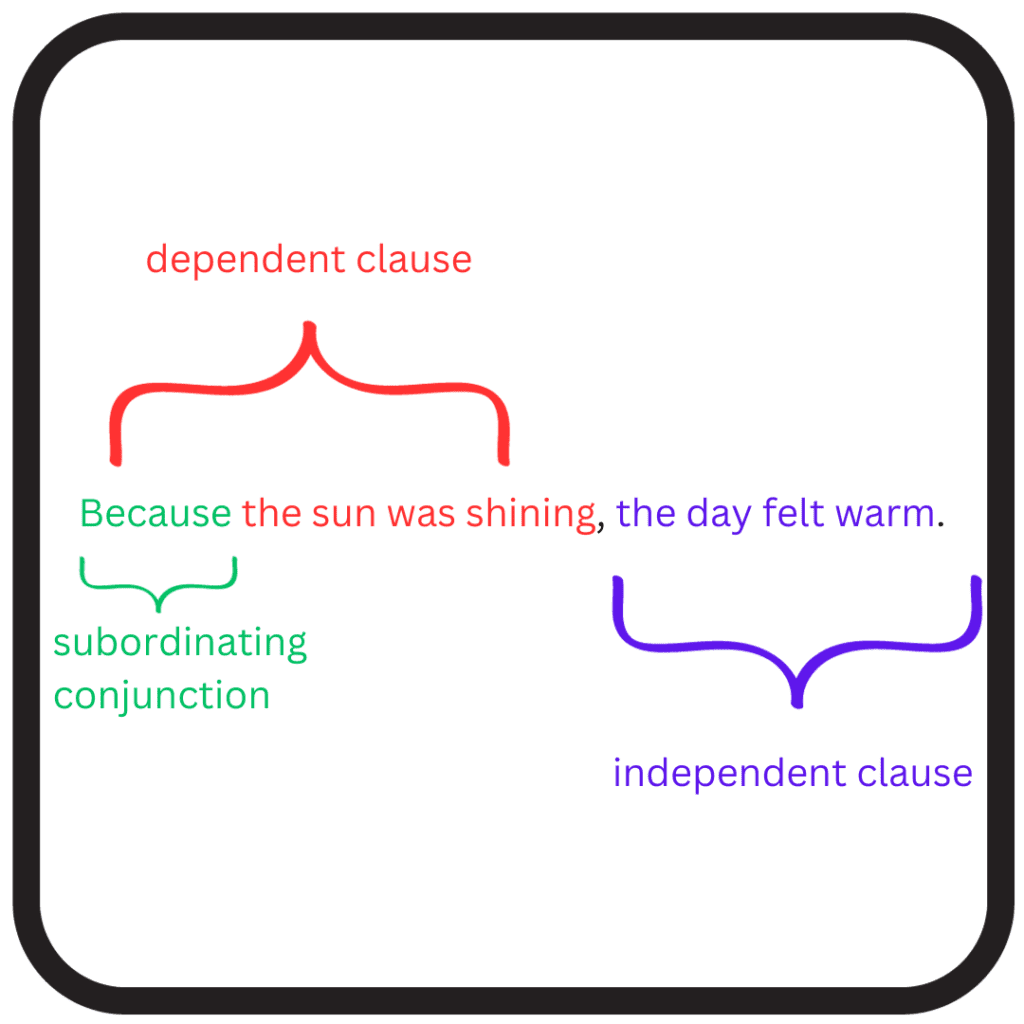
Example: “Because the sun was shining, the day felt warm.”
In the example above, “Because the sun was shining” is a dependent clause because it doesn’t express a complete thought on its own. It relies on the independent clause “the day felt warm” to form a complete sentence.
What is a complex sentence?
A complex sentence is a type of sentence that contains an independent clause and one or more dependent clauses.
These clauses are joined together by subordinating conjunctions or relative pronouns.
What are subordinating conjunctions?
Subordinating conjunctions are words that join a subordinate (dependent) clause to a main (independent) clause.
Here is a list of subordinating conjunctions along with examples in sentences.
- After: After the storm passed, we went outside to assess the damage.
- Although: Although it was snowing, they decided to go for a walk.
- As: She sang softly to herself as she walked through the empty corridors.
- Because: He couldn’t go to the party because he had a family commitment.
- Before: Finish your dinner before you go out to play.
- If: If you study consistently, you’ll perform well in exams.
- Since: I haven’t seen her since the school reunion last year.
- Though: Though it was late, they continued working on the project.
- Until: She waited patiently until the bus arrived.
- When: The alarm went off when he opened the door.
- Whenever: Call me whenever you need assistance.
- Where: We’ll meet at the café where we first met.
- While: She listened to music while she cleaned her room.
- As if/As though: He acted as if nothing had happened.
- Because of: She was late because of the heavy traffic.
- Even though: Even though it was hot, they wore jackets.
- In case: Take an umbrella in case it rains.
- Now that: Now that the sun has set, it’s getting cooler.
- Provided that: You can borrow my car provided that you return it by tomorrow.
Whether: I don’t know whether she’ll come to the party.
Classifying subordinating conjunctions according to their functions
These conjunctions serve various purposes therefore they can be categorizable into groups based on their functions.
This classification aids in memorization and application. Let’s explore them by their primary roles:
Time:
- After: After the storm passed, we went outside to assess the damage.
- Before: Finish your dinner before you go out to play.
- When: The alarm went off when he opened the door.
Cause:
- Because: He couldn’t go to the party because he had a family commitment.
- Since: I haven’t seen her since the school reunion last year.
Condition:
- If: If you study consistently, you’ll perform well in exams.
- Unless: I won’t leave unless you ask me to.
Contrast:
- Although: Although it was snowing, they decided to go for a walk.
- Though: Though it was late, they continued working on the project.
Purpose:
- So that: He worked hard so that he could achieve his goals.
- In order that: She saved money in order that she could travel.
Comparison:
- As: She sang softly to herself as she walked through the empty corridors.
- Than: She is taller than her younger sister.
Location:
- Where: We’ll meet at the café where we first met.
- Wherever: Go wherever your heart takes you.
Manner:
- As if/As though: He acted as if nothing had happened.
- Like: She runs like the wind.
How to make complex sentences using subordinating conjunctions?
- Start with an independent clause, a complete thought that can stand alone as a sentence.
- Then, introduce a dependent clause using subordinating conjunctions to provide additional information, show relationships, or indicate time, cause, or condition.
- For example, instead of saying, “I finished homework. I went to bed,” you can create a complex sentence by saying, “After I finished my homework, I went to bed.”
- The subordinating conjunction “after” connects the two clauses, making the relationship between finishing work and going to bed clear.
- Experiment with various subordinating conjunctions such as “although,” “because,” “when,” and “while” to diversify your sentence structures.
It’s essential to follow specific grammar rules to ensure clarity and coherence. Here are some key guidelines:
- Place the subordinating conjunction at the beginning of the dependent (subordinate) clause. Example: “Although it was snowing, they decided to go for a walk.”
- When the dependent clause comes first, use a comma to separate it from the independent clause. Example: “Because he had a family commitment, he couldn’t go to the party.”
- If the independent clause comes first, you generally don’t need a comma. Example: “She went to bed after she finished her work.”
To sum it up, knowing about different sentence parts—dependent and independent clauses—is crucial for making accurate complex sentences. A practical way to get better at this is by picking a subordinating conjunction (like “although”) and making at least three sentences with it. For example, you could say, “Although the sun was shining, it wasn’t that warm” Also, try looking at academic readings to see how experts use these joining words. With regular practice, you’ll become really good at creating complex sentences. Keep practicing and enjoy improving your writing!